Science & Culture
Bioethics of Gender in Sport
Geair Justice '29
Using testosterone levels to determine whether an athlete is eligible to compete in women’s sport is one of the most controversial ethical issues in modern athletics (World Athletics, 2018). From a scientific standpoint, testosterone plays a significant role in athletic performance through its effects on muscle mass, hemoglobin concentration, and recovery capacity. As an androgenic hormone, testosterone binds to receptors in skeletal muscle tissue, promoting protein synthesis and contributing to increases in muscle size and strength. It also stimulates erythropoiesis, leading to elevated hemoglobin levels and enhanced oxygen-carrying capacity, which is particularly relevant for endurance performance. These physiological mechanisms help explain why testosterone is often considered a key factor in sex-based performance differences (Handelsman et al., 2018).
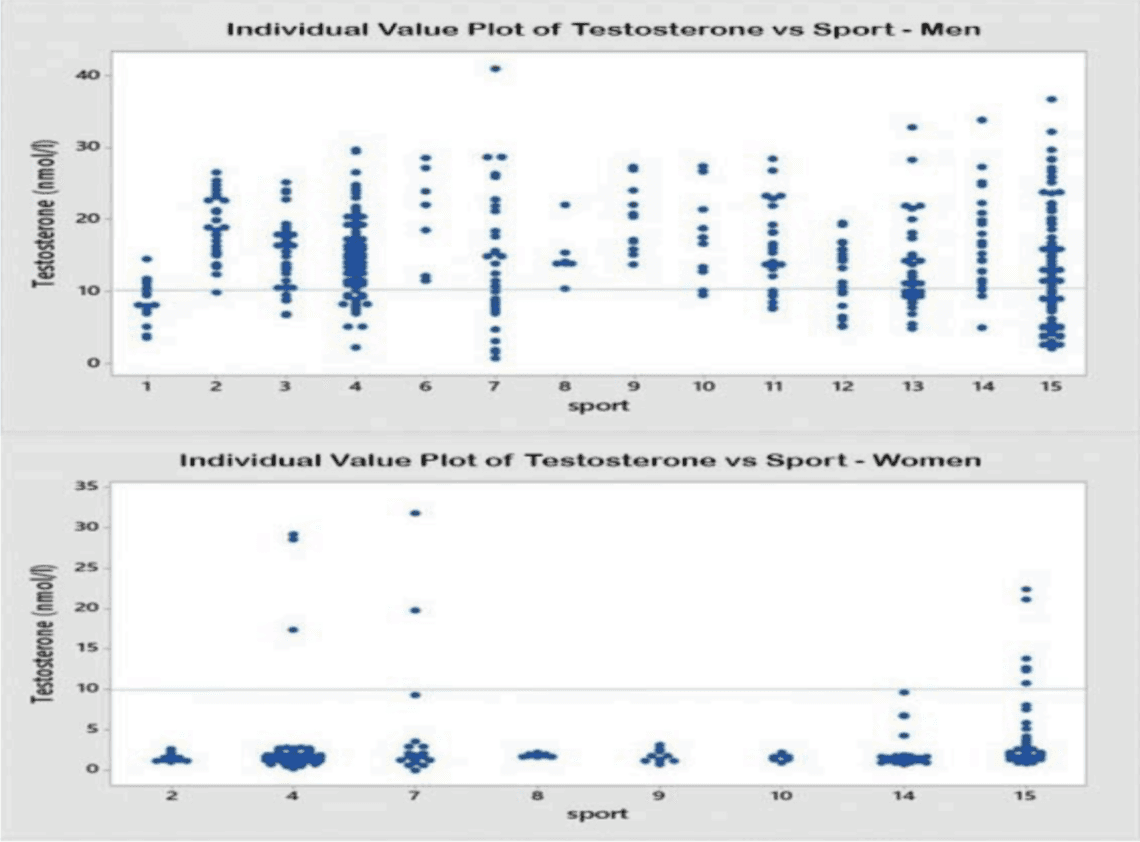
At the same time, the relationship between testosterone and athletic performance is complex and not strictly deterministic. Athletic success is shaped by multiple interacting variables, including training intensity, access to resources, genetics, and environmental conditions. Even at the elite level, there is substantial overlap in testosterone levels and performance outcomes across athletes, making it difficult to isolate testosterone as a singular cause of competitive advantage (Bermon et al., 2014). This scientific variability complicates efforts to establish clear eligibility thresholds based solely on hormonal levels and raises questions about whether such thresholds can be both biologically accurate and ethically justified.
Since the International Association of Athletics Federations (IAAF, now World Athletics) enacted their Differences of Sex Development (DSD) regulations, athletes such as Caster Semenya have been placed at the center of debates over science, fairness, and gender identity. Scientific and ethical debates surrounding testosterone regulation have produced competing interpretations, reflected in the work of Sigmund Loland (2020) and Jaime Schultz (2021). Both authors seek to understand how sport can maintain fairness while acknowledging biological and social complexity, but their conclusions diverge significantly. Loland approaches testosterone regulation as part of the moral structure of sport, arguing that fair equality of opportunity can justify classification. Schultz, by contrast, frames the issue as a “wicked problem,” one that resists resolution because it is deeply entangled with historical inequalities and scientific uncertainty. Their contrasting perspectives highlight how biological complexity shapes ethical disagreement.
In Caster Semenya, athlete classification, and fair equality of opportunity in sport, Loland (2020) constructs a normative argument grounded in a Rawlsian conception of fairness. Central to his position is the idea that sport is legitimate only if athletes compete on an equal footing of effort and talent, rather than benefiting from unearned biological advantages. Loland distinguishes between “stable inequalities,” such as sex, age, or body size, and “dynamic inequalities,” such as skill, training, and discipline (Loland, 2020, p. 585). Stable inequalities that systematically influence performance, he argues, provide moral justification for classification systems designed to preserve fairness.
From a scientific perspective, testosterone appears to fit within Loland’s category of a stable inequality. Empirical research has identified correlations between higher endogenous androgen levels and improved performance in certain track and field events (Bermon et al., 2014). These findings suggest that testosterone may contribute to measurable advantages in physiological domains such as muscle strength, power output, and endurance capacity. In this sense, regulating testosterone levels could be interpreted as an attempt to reduce biologically rooted disparities that fall outside the realm of individual effort.
However, the scientific evidence supporting this position remains contested. Critics have argued that the correlations identified in such studies are inconsistent across different events and do not establish a clear causal relationship between testosterone levels and performance outcomes. Furthermore, research highlighted by American Association for the Advancement of Science (2026) questions whether existing data are sufficient to justify exclusionary policies based on hormonal thresholds. These critiques emphasize that performance outcomes arise from a complex interaction of physiological systems—including neuromuscular coordination, cardiovascular efficiency, and metabolic adaptation—making it difficult to isolate testosterone as a single determining factor (Karkazis et al., 2012).
This scientific uncertainty complicates Loland’s ethical framework. While his argument depends on the assumption that biologically based advantages can be clearly identified and regulated, the available evidence suggests that such advantages are neither uniform nor easily measurable. As a result, the notion that testosterone can serve as a stable and morally neutral basis for classification becomes increasingly difficult to sustain.
Loland situated his argument within a broader conception of merit in sport. Athletic success, he argues, reflects a synthesis of innate talent, disciplined training, and psychological resilience. Classification systems are therefore necessary to ensure that competition rewards effort and skill rather than arbitrary biological differences. While Loland acknowledges that sex testing policies involve significant ethical trade-offs, he ultimately offers conditional support for testosterone regulation, describing it as a “reasonable and proportionate” means of preserving fairness (p. 586). Yet this conclusion rests on the assumption that scientific thresholds can be both stable and universally applicable—an assumption that is directly challenged by Schultz.
In contrast to Loland’s defense of classification, Schultz (2021) situates testosterone regulation within a broader historical and scientific context. Drawing on the concept of “wicked problems,” originally developed by Rittel and Webber (1973), she argues that defining eligibility in women’s sport cannot be resolved through technical or scientific means alone. Wicked problems are characterized by their complexity, lack of clear boundaries, and resistance to definitive solutions. Each attempt to resolve such a problem generates new forms of uncertainty and unintended consequences.
Developments in biological science reinforce Schultz’s argument by demonstrating that sex is not a strictly binary category. Intersex variations, including Differences of Sex Development (DSD), reveal that chromosomal, hormonal, and anatomical traits do not always align in predictable ways. For example, individuals with androgen insensitivity may possess XY chromosomes but develop typically female physical characteristics, while others exhibit naturally elevated testosterone levels without corresponding performance advantages (Ainsworth, 2015; Hirschberg, 2019). This biological diversity challenges the assumption that a single measurable variable such as testosterone can reliably define sex categories.
Rather than clarifying classification, scientific advances have made biological categories more complex and less stable. Research on female hyperandrogenism further illustrates this point by showing that elevated endogenous testosterone does not produce uniform or predictable effects across individuals (Hirschberg, 2019). These findings undermine the idea that testosterone can function as a clear boundary marker between male and female athletic categories. Schultz’s argument extends beyond biology to consider the historical and social dimensions of sex testing in sport. She traces how, since the early twentieth century, sports organizations have sought to regulate gender ambiguity through increasingly technical methods, including visual inspection, chromosomal testing, and hormonal measurement. Although these methods have been presented as objective and scientific, they have often been shaped by broader social forces, including sexism, racism, and colonialism. As Schultz demonstrates, such policies have disproportionately affected women of color from the Global South, including athletes such as Caster Semenya.
In this context, testosterone cannot be understood as a neutral biological marker. Instead, it functions as a socially embedded tool of regulation, reflecting broader assumptions about gender, fairness, and the authority of scientific knowledge. Schultz therefore argues that attempts to resolve the issue through more precise measurement are unlikely to succeed, as they fail to address the underlying complexity of the problem. The divergence between Loland and Schultz reveals a deeper tension between scientific measurement and ethical interpretation. Loland assumes that biological differences can be quantified and incorporated into fair regulatory systems, while Schultz argues that such quantification inevitably produces exclusion. Scientific evidence does not fully resolve this disagreement. While testosterone influences physiological traits relevant to performance, it does not operate as a universal or sufficient determinant. Instead, athletic performance emerges from a network of interacting biological and environmental factors, many of which cannot be reduced to a single measurable parameter (Handelsman et al., 2018; Hirschberg, 2019).
This limitation has significant implications for sports governance. If fairness depends on the ability to define clear and stable categories, and if those categories rely on incomplete or contested scientific knowledge, then regulatory systems may struggle to achieve their intended goals. Attempts to enforce fairness through hormonal thresholds risk oversimplifying biological reality and excluding athletes whose bodies do not conform to conventional expectations.
Taken together, the scientific literature does not provide a definitive resolution to the debate over testosterone regulation in sport. Instead, it highlights the limitations of using a single biological variable to define complex human variation. While testosterone contributes to performance differences in certain contexts, its effects are mediated by a wide range of interacting factors, and significant overlap exists across individuals. Studies of elite athletes reveal both correlations and inconsistencies, underscoring the difficulty of drawing clear boundaries based on hormonal levels alone (Bermon et al., 2014; Karkazis et al., 2012).
The debate therefore extends beyond policy into the limits of scientific knowledge itself. When fairness depends on classification, and classification relies on evolving and contested science, the ethical challenge is no longer simply how to regulate competition, but whether existing frameworks are capable of supporting the demands placed upon them. In this sense, the controversy surrounding testosterone regulation reflects a broader tension between the desire for objective standards and the complex realities of human biology.
References
Ainsworth, C. (2015). Sex redefined. Nature, 518(7539), 288–291.
https://doi.org/10.1038/518288a
Allen, S. (2026). Does the science support a ban on female athletes with high testosterone levels? | American Association for the Advancement of Science (AAAS). American Association for the Advancement of Science (AAAS).
https://www.aaas.org/membership/qualia/does-science-support-ban-female-athletes-high testosterone-levels
Bermon, S., Garnier, P. Y., Hirschberg, A. L., Robinson, N., Giraud, S., Nicoli, R., Baume, N., Saugy, M., Fénichel, P., Bruce, S. J., Henry, H., Dollé, G., & Ritzen, M. (2014). Serum androgen levels in elite female athletes. The Journal of Clinical Endocrinology & Metabolism, 99(11), 4328–4335. https://doi.org/10.1210/jc.2014-1391
Foddy, B., & Savulescu, J. (2010). Time to re-evaluate gender segregation in athletics? British Journal of Sports Medicine, 45(15), 1184–1188.
https://doi.org/10.1136/bjsm.2010.071639
Handelsman, David J, et al. “Circulating Testosterone as the Hormonal Basis of Sex Differences in Athletic Performance.” Endocrine Reviews, vol. 39, no. 5, 13 July 2018, pp. 803–829, academic.oup.com/edrv/article/39/5/803/5052770, https://doi.org/10.1210/er.2018-00020.
Hirschberg, A. L. (2019). Female hyperandrogenism and elite sport. Endocrine Abstracts. https://doi.org/10.1530/endoabs.63.s29.1
Karkazis, K., Jordan-Young, R., Davis, G., & Camporesi, S. (2012). Out of Bounds? A Critique of the New Policies on Hyperandrogenism in Elite Female Athletes. The American Journal of Bioethics, 12(7), 3–16. https://doi.org/10.1080/15265161.2012.680533
Loland, S. (2020). Caster Semenya, athlete classification, and fair equality of opportunity in sport. Journal of Medical Ethics, 46(9), 584–590.
https://doi.org/10.1136/medethics-2019-105937
Schultz, J. (2019). Good enough? The ‘wicked’ use of testosterone for defining femaleness in women’s sport. Sport in Society, 24(4), 607–627.
https://doi.org/10.1080/17430437.2019.1703684
Wiesemann, C. (2011). Is there a right not to know one’s sex? The ethics of ‘gender verification’ in women’s sports competition. Journal of Medical Ethics, 37(4), 216–220. https://doi.org/10.1136/jme.2010.039081
Image credits:
https://www.biointeractive.org/sites/default/files/TestosteroneAthletes-Educator-DP.pdf
Read More

Reese Kugel '29
The Gut Feeling: How Serotonin’s True Origin Is Reshaping Our Understanding of Depression
Research on gut-derived serotonin is reshaping traditional views of depression and antidepressant treatment.

Soham Shah '29
A Perspective on Artificial Intelligence in Healthcare
AI improves diagnostic speed and accuracy, but for treatment it must stay a support tool because of ethical, legal, empathy issues.
Kevin He '29
Universal Base-Edited CAR7 T-Cell Therapy to Treat Relapsed T-cell Acute Lymphoblastic Leukemia (T-ALL)
Base-edited CAR-T therapy offers new hope for relapsed T-ALL by inducing remission and bridging patients to stem cell transplant.