Neuroscience
Rejuvenating Senescent Dopaminergic Neurons: A Novel Therapeutic Approach to Parkinson's Disease
Keigo Fujita '29
Parkinson’s Disease
Parkinson’s Disease (PD) is the second most prevalent neurodegenerative disorder, affecting 2-3% of people over 65 years old. PD is characterized by tremors and bradykinesia, which results from the degeneration of dopaminergic (DA) neurons in the substantia nigra (SN) that project into the striatum (Poewe et al., 2017).
The pathological hallmark of PD is the aggregation of α-synuclein, a protein involved in synaptic vesicle recycling and modulation of dopamine transmission in SN neurons. These α-synuclein aggregates are called Lewy bodies (Reeve et al., 2015). Pathological α-synuclein can lead to oxidative stress, complex I impairment, and other mitochondrial failures. Oxidative stress can impair the ubiquitin-proteasome system, causing abnormal protein accumulation. This leads to a vicious cycle of oxidative stress, α-synuclein aggregation, and neuronal death. Aggregation of α-synuclein in non-neuronal cells, such as microglia and astrocytes, can also lead to oxidative stress, neuroinflammation, and other deleterious effects. The aggregation of α-synuclein causes these non-neuronal support cells to secrete reactive oxygen species (ROS) and various cytokines that can accelerate neuronal cell death in PD (Calabresi et al., 2023).
Cellular Senescence
Cellular senescence is another consequence of excessive stress, including oxidative stress and mitochondrial deterioration. Senescence is a metabolically active state of permanent cell-cycle arrest that prevents the spread of damage to the next cell generation. Though senescence typically is a necessary tumor-suppressive mechanism, it can have deleterious effects. The most potent of these is the senescence-associated secretory phenotype (SASP). The SASP is characterized by the secretion of interleukins, growth factors, and inflammatory cytokines. This provides another source of neuroinflammation that can adversely affect DA neurons (Coppé et al., 2010). Similar to the viscous cycle seen in pathological α-synuclein aggregation, the SASP can induce neighboring cells into a SASP state.
The term “senescence” is derived from the latin senex, meaning “old man,” the same etymological root for “senile.” As age is the biggest risk factor for neurodegenerative disorders, the connection between cellular senescence and PD is unsurprising. Because senescence has been identified as a tumor-suppressive mechanism, it is not readily apparent that non-proliferating cells like neurons can exhibit cellular senescence. Yet, recent research has shown that neurons exhibit a variety of senescent hallmarks, including elevated expression of p-p38, γH2AX and macro-H2A, IL-6 and oxidative stress, increased SA-β-Gal activity, and accumulation of lipofuscin (Jurk et al., 2012). Additionally, these senescent neurons can express the SASP, inducing nearby cells into senescence thus leading to neurodegeneration. Non-neuronal support cells have also been shown to demonstrate cellular senescence and the SASP (Si et al., 2021). This evidence suggests that there is an inflammatory environment in the SN that can induce cellular senescence in DA neurons, causing PD.
Previous Therapeutic Approaches
Cell Replacement
Cell replacement is a popular approach to PD with the development of stem cell technology. This approach seeks to replace degenerated DA neurons with dopaminergic progenitors derived from stem cells. Recent approaches that attempted to transplant these grafts directly into the striatum saw minimal success. This approach alters the healthy brain architecture, which has axonal projections from the SN to the striatum. The difficulty of guiding the axons of transplanted DA neurons along the nigrostriatal pathway presents a formidable challenge (De Vincentiis et al., 2025). In addition to this overarching topological limitation, the transplantation of grafts suffer from low survival rate of transplanted cells, incomplete differentiation in vivo, and graft-induced dyskinesias (Parmar et al., 2020).
Senolytics
Senolytic drugs have shown promise in age-related diseases through their capability to selectively eliminate senescent cells. The combination of dasatinib and querecin can kill senescent cells while sparing proliferating cells (Zhu et al., 2015). When applied to aged mice, this senolytic cocktail reduced the population of senescent microglia and the expression of the SASP. Aged mice with this treatment showed significant improvements in cognitive function, validating senolytics as a potential approach to age-related neurodegenerative disorders like PD (Ogrodnik et al., 2021).
While this approach is effective on peripheral tissues with mitotic cells, senolytics present a fundamental problem when applied to non-dividing senescent DA neurons. Unlike dividing cells like microglia, senescent DA neurons eliminated by senolytics cannot be replenished.
Though cell replacement and senolytics both have potential as therapeutic approaches to PD, both approaches treat senescent neurons as functionally irreparable.
Rejuvenating Senescent Cells
Cellular senescence in neurons suggests the theoretical possibility of a third, less-explored approach, which seeks to capitalize on the existing neuron architecture.
Instead of introducing new DA neuron grafts or eliminating senescent neurons, this approach would rejuvenate existing senescent neurons. Because senescent DA neurons are still metabolically active, there is potential to revert them to a healthy non-senescent state. This approach attempts to avoid the topology issue because these senescent neurons have already been innervated with striatal neurons.
Recent advances in cell reprogramming present a proof-of-principle that senescence reversal is attainable through chemical means. Yang et al. (2023) identified six small molecule chemical cocktails that can restore a youthful genome-wide transcript profile and reverse transcriptomic age in senescent fibroblasts in less than a week. These cocktails restored cells to a youthful state without altering cellular identity or inducing pluripotency, suggesting that this approach might be able to rejuvenate neurons without dedifferentiating them (Yang et al., 2023). If applied to senescent DA neurons, this means youthful neuron function can be restored while differentiated neuron arborization is preserved.
This chemical approach has potential in PD pathology and other neurodegenerative diseases because the small molecules can cross the blood-brain barrier and avoid safety concerns associated with viral delivery methods. While these rejuvenation techniques have not yet been studied in post-mitotic neurons or in vivo PD models, this study establishes that senescence can be reversed while maintaining cellular identity and validates senescent DA neurons as a pharmacological target.
SATB1, a DNA binding protein, is a known PD risk factor. Riessland et al. (2019) reports that SATB1 prevents cellular senescence in post-mitotic DA neurons and that loss of SATB1 can trigger a senescence transcriptional program both in vivo and in vitro. SATB1 knockout mice DA neurons showed the full spectrum of senescence hallmarks, including the activation of the SASP and a dramatic increase in SA-β-gal activity. SATB1 knockout stem cells differentiated into DA neurons similarly exhibited cellular senescence. However, when the same SATB1 stem cells were differentiated into cortical neurons, senescence effects were not found, demonstrating that DA neurons are uniquely vulnerable to senescence (Riessland et al., 2019). These results provide proof-of-principle that PD pathology is characterized by senescent but salvageable DA neurons, validating rejuvenation as a therapeutic approach.
Discussion
The ability to rejuvenate senescent cells opens a new therapeutic avenue for PD that addresses fundamental limitations of existing approaches. A single human SN DA neuron is estimated to give rise to 1-2.4 million synapses in the striatum (Bolam & Pissadaki, 2012). While cell replacement attempts to recreate the complex arborization of DA neurons and senolytics risk exacerbating neuronal loss, rejuvenation strategies attempt to restore function to existing neurons while preserving their morphology.
The work of Riessland et al. (2019) establishes both in vitro and in vivo experimental models for senescent DA neurons in PD. These models can be a testing ground to investigate the efficacy of small molecule cocktails in rejuvenating senescent post-mitotic neurons. Yang et al. (2023) shows that applying these cocktails to senescent fibroblasts maintains cellular identity, a crucial property for DA neuron rejuvenation.
Still, many challenges remain. First, though DA neurons have been shown to be susceptible to senescence, the actual proportion of DA neurons that are senescent versus dead is still unclear. This distinction proves difficult to investigate because it is often unclear whether a cell has entered senescence (Avelar et al., 2020). The current approach to identifying senescence typically involves analyzing the presence of gene sets that attempt to characterize the senescent transcriptome (Saul et al., 2022). While many hallmarks signs of cellular senescence have been identified, no single indicator is enough on its own to reliably determine senescence. Second, the chemical cocktails optimized for fibroblasts may need to be adapted for neurons. Finally, rejuvenated senescent neurons may re-enter senescence if underlying α-synuclein pathology persists.
Despite these limitations, recent discoveries that senescence can be induced in DA neurons and that chemical rejuvenation is possible suggest that rejuvenating neurons is a testable hypothesis with therapeutic potential for PD.
Works Cited
Avelar, R. A., Ortega, J. G., Tacutu, R., Tyler, E. J., Bennett, D., Binetti, P., Budovsky, A., Chatsirisupachai, K., Johnson, E., Murray, A., Shields, S., Tejada-Martinez, D., Thornton, D., Fraifeld, V. E., Bishop, C. L., & De Magalhães, J. P. (2020). A multidimensional systems biology analysis of cellular senescence in aging and disease. Genome Biology, 21(1), 91. https://doi.org/10.1186/s13059-020-01990-9
Bolam, J. P., & Pissadaki, E. K. (2012). Living on the edge with too many mouths to feed: Why dopamine neurons die. Movement Disorders, 27(12), 1478–1483. https://doi.org/10.1002/mds.25135
Calabresi, P., Mechelli, A., Natale, G., Volpicelli-Daley, L., Di Lazzaro, G., & Ghiglieri, V. (2023). Alpha-synuclein in Parkinson’s disease and other synucleinopathies: From overt neurodegeneration back to early synaptic dysfunction. Cell Death & Disease, 14(3), 176. https://doi.org/10.1038/s41419-023-05672-9
Coppé, J.-P., Desprez, P.-Y., Krtolica, A., & Campisi, J. (2010). The Senescence-Associated Secretory Phenotype: The Dark Side of Tumor Suppression. Annual Review of Pathology: Mechanisms of Disease, 5(1), 99–118. https://doi.org/10.1146/annurev-pathol-121808-102144
De Vincentiis, S., Capitanini, E., Kira, K., Dell’Amico, C., Takahashi, J., Onorati, M., Raudzus, F., & Raffa, V. (2025). Mechanical Forces Guide Axon Growth through the Nigrostriatal Pathway in an Organotypic Model. Advanced Science, 12(31), 2500400. https://doi.org/10.1002/advs.202500400
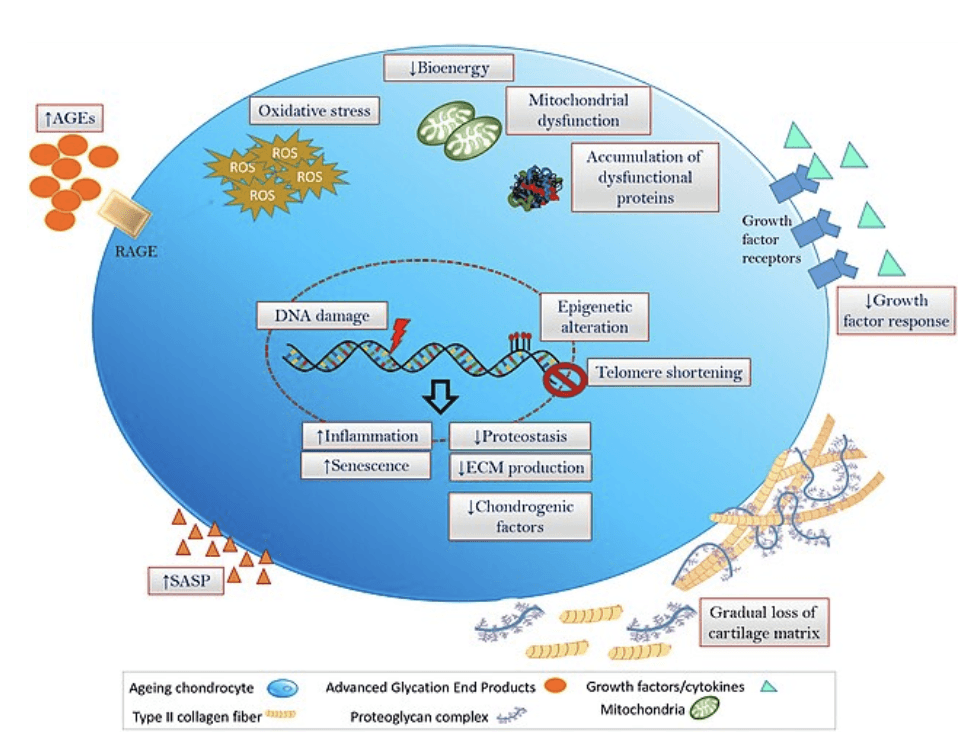
IM, R. T., Yee YM and Khan. (2021). Figure 1. Hallmarks of chondrocyte aging inflammation, oxidative stress (excess production and accumulation of ROS and the related dysfunctioning of cellular components) and senescence are fundamental events that is associated with the onset of cellular aging and aging-associated degenerative disorders. Chondrocytes undergoing aging at multiple levels including genetic/epigenetic aberration, disruption in biochemical and bioenergetics related cellular processes, modulation of ECM and cartilage niche, leading to the degeneration of cartilage and onset of OA. [Graphic]. https://www.frontiersin.org/journals/cell-and-developmental-biology/articles/10.3389/fcell.2021.625497/full Ramasamy TS, Yee YM and Khan IM (2021) Chondrocyte Aging: The Molecular Determinants and Therapeutic Opportunities. Front. Cell Dev. Biol. 9:625497. doi: 10.3389/fcell.2021.625497. https://commons.wikimedia.org/wiki/File:Hallmarks_of_chondrocyte_aging_inflammation,_oxidative_stress_(excess_production_and_accumulation_of_ROS_and_the_related_dysfunctioning_of_cellular_components)_and_senescence.jpg
_and_senescence.jpg)
Jurk, D., Wang, C., Miwa, S., Maddick, M., Korolchuk, V., Tsolou, A., Gonos, E. S., Thrasivoulou, C., Jill Saffrey, M., Cameron, K., & Von Zglinicki, T. (2012). Postmitotic neurons develop a p21‐dependent senescence‐like phenotype driven by a DNA damage response. Aging Cell, 11(6), 996–1004. https://doi.org/10.1111/j.1474-9726.2012.00870.x
Ogrodnik, M., Evans, S. A., Fielder, E., Victorelli, S., Kruger, P., Salmonowicz, H., Weigand, B. M., Patel, A. D., Pirtskhalava, T., Inman, C. L., Johnson, K. O., Dickinson, S. L., Rocha, A., Schafer, M. J., Zhu, Y., Allison, D. B., Von Zglinicki, T., LeBrasseur, N. K., Tchkonia, T., … Jurk, D. (2021). Whole‐body senescent cell clearance alleviates age‐related brain inflammation and cognitive impairment in mice. Aging Cell, 20(2), e13296. https://doi.org/10.1111/acel.13296
Parmar, M., Grealish, S., & Henchcliffe, C. (2020). The future of stem cell therapies for Parkinson disease. Nature Reviews Neuroscience, 21(2), 103–115. https://doi.org/10.1038/s41583-019-0257-7
Poewe, W., Seppi, K., Tanner, C. M., Halliday, G. M., Brundin, P., Volkmann, J., Schrag, A.-E., & Lang, A. E. (2017). Parkinson disease. Nature Reviews Disease Primers, 3(1), 17013. https://doi.org/10.1038/nrdp.2017.13
Reeve, A. K., Ludtmann, M. H., Angelova, P. R., Simcox, E. M., Horrocks, M. H., Klenerman, D., Gandhi, S., Turnbull, D. M., & Abramov, A. Y. (2015). Aggregated α-synuclein and complex I deficiency: Exploration of their relationship in differentiated neurons. Cell Death & Disease, 6(7), e1820–e1820. https://doi.org/10.1038/cddis.2015.166
Riessland, M., Kolisnyk, B., Kim, T. W., Cheng, J., Ni, J., Pearson, J. A., Park, E. J., Dam, K., Acehan, D., Ramos-Espiritu, L. S., Wang, W., Zhang, J., Shim, J., Ciceri, G., Brichta, L., Studer, L., & Greengard, P. (2019). Loss of SATB1 Induces p21-Dependent Cellular Senescence in Post-mitotic Dopaminergic Neurons. Cell Stem Cell, 25(4), 514-530.e8. https://doi.org/10.1016/j.stem.2019.08.013
Saul, D., Kosinsky, R. L., Atkinson, E. J., Doolittle, M. L., Zhang, X., LeBrasseur, N. K., Pignolo, R. J., Robbins, P. D., Niedernhofer, L. J., Ikeno, Y., Jurk, D., Passos, J. F., Hickson, L. J., Xue, A., Monroe, D. G., Tchkonia, T., Kirkland, J. L., Farr, J. N., & Khosla, S. (2022). A new gene set identifies senescent cells and predicts senescence-associated pathways across tissues. Nature Communications, 13(1), 4827. https://doi.org/10.1038/s41467-022-32552-1
Si, Z., Sun, L., & Wang, X. (2021). Evidence and perspectives of cell senescence in neurodegenerative diseases. Biomedicine & Pharmacotherapy, 137, 111327. https://doi.org/10.1016/j.biopha.2021.111327
Yang, J.-H., Petty, C. A., Dixon-McDougall, T., Lopez, M. V., Tyshkovskiy, A., Maybury-Lewis, S., Tian, X., Ibrahim, N., Chen, Z., Griffin, P. T., Arnold, M., Li, J., Martinez, O. A., Behn, A., Rogers-Hammond, R., Angeli, S., Gladyshev, V. N., & Sinclair, D. A. (2023). Chemically induced reprogramming to reverse cellular aging. Aging, 15(13), 5966–5989. https://doi.org/10.18632/aging.204896
Zhu, Y., Tchkonia, T., Pirtskhalava, T., Gower, A. C., Ding, H., Giorgadze, N., Palmer, A. K., Ikeno, Y., Hubbard, G. B., Lenburg, M., O’Hara, S. P., LaRusso, N. F., Miller, J. D., Roos, C. M., Verzosa, G. C., LeBrasseur, N. K., Wren, J. D., Farr, J. N., Khosla, S., … Kirkland, J. L. (2015). The Achilles’ heel of senescent cells: From transcriptome to senolytic drugs. Aging Cell, 14(4), 644–658. https://doi.org/10.1111/acel.12344
Read More

Reese Kugel '29
The Gut Feeling: How Serotonin’s True Origin Is Reshaping Our Understanding of Depression
Research on gut-derived serotonin is reshaping traditional views of depression and antidepressant treatment.

Soham Shah '29
A Perspective on Artificial Intelligence in Healthcare
AI improves diagnostic speed and accuracy, but for treatment it must stay a support tool because of ethical, legal, empathy issues.
Kevin He '29
Universal Base-Edited CAR7 T-Cell Therapy to Treat Relapsed T-cell Acute Lymphoblastic Leukemia (T-ALL)
Base-edited CAR-T therapy offers new hope for relapsed T-ALL by inducing remission and bridging patients to stem cell transplant.