Health Sciences
How Creative Global Health Solutions with Animals Have Redefined Testing and Prevention.
Brandon Lee '28
In global health, one of the most pressing issues remains access to and continuity of care. Limited resources, human error, and financial constraints make testing and subsequent care challenging to extend globally. According to the WHO,
“The expansion of UHC [Universal Health Coverage] is insufficient, with only about 431 million additional people gaining access to essential health services…and only a projected 500 million by 2025 – just half of the targeted one billion.” (World Health Organization, 2025)
Accordingly, creative solutions to global health issues are necessary to fill the gaps in health coverage.
Imagine rats testing human samples for diseases, or the intentional release of a particular kind of mosquitoes to prevent the transmission of the very disease they carry. The following examples are fascinating stories of how scientists and researchers have worked with the environment and its animals to generate change in global health.
Rats and Tuberculosis
Tuberculosis (TB) is an infectious disease that affects the lungs. TB is an airborne illness associated with HIV as the probability of developing TB is higher among people infected with HIV. TB is considered a global health epidemic with an estimated 10.6 million people infected and 1.6 million dead in 2021 (World Health Organization, 2022). The common types of tests for TB in America are blood and skin testing (Center for Disease Control and Prevention, 2024). However, worldwide, sputum smear microscopy (SSM) is the most common. SSM was developed over a 100 years ago, and requires an individual to look through a microscope at each sample to determine a diagnosis (World Health Organization, 2013).
SSM is widely used in global health: if an organization wishes to go into a place without medical infrastructure, they will set up a mobile clinic and send all samples for testing there. Difficulties arise in following up with those tested, securing patient access to mobile clinics, and funding the cost of operations. There are an estimated 3 million undiagnosed cases of TB each year (Alsdurf, H., Empringham, 2021), so there is significant room for improvement.
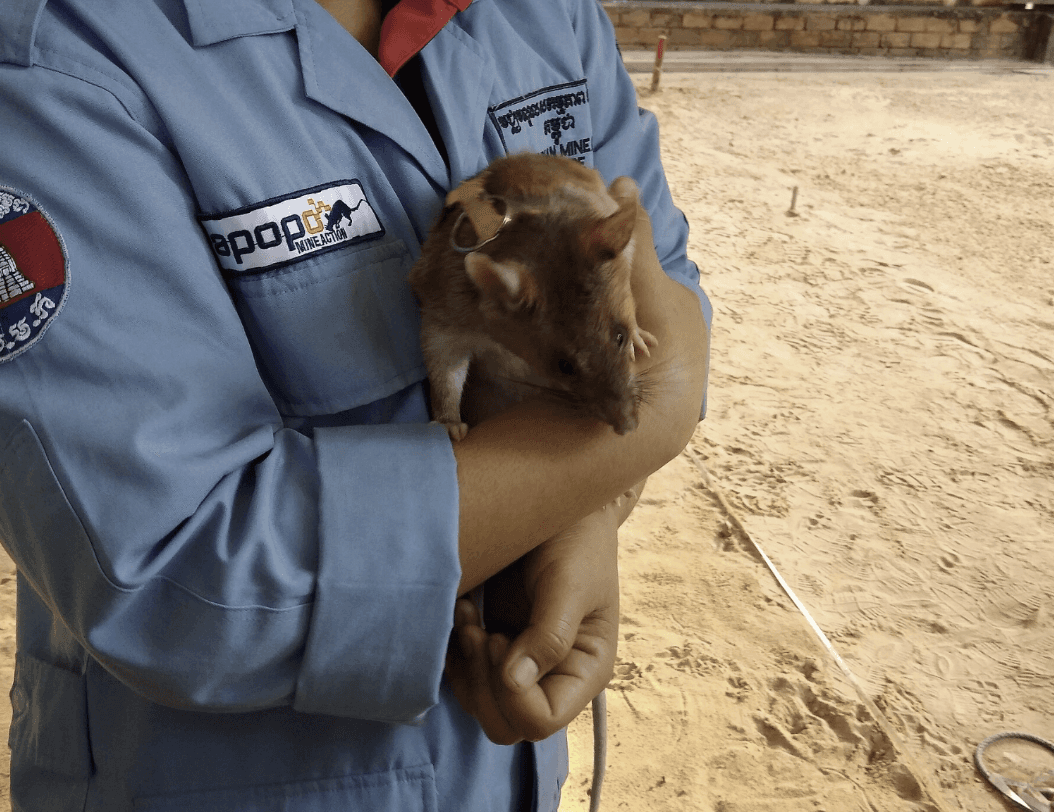
Giant African Pouched Rats are changing the testing process while helping to supplement costs. Instead of paying individuals to laboriously examine each sputum sample, a rat can identify which samples are infected. Like dogs, the rats have an amazing sense of smell, and can use their sense of smell to identify samples infected with M. tuberculosis, which is the bacteria that causes TB (Poling, A., 2011). Since they are small and light, these rats can be taken out into communities to test samples anywhere.
APOPO is the organization that trains the rats. The rats are trained from birth and go through various tests to meet the requirements for field work. When the rats test samples, they are trained to pause over infected samples for 3 seconds (APOPO, Our impact: Detecting tuberculosis). The rats are trained until they have at least an 80% hit rate and less than a 5% false alarm rate. In one study, 15,041 samples were screened with traditional human sputum smear microscopy, and the same samples were then tested with the rats. Human technicians identified 1,838 humans with TB, and the rats identified 2,415 humans with TB, marking a significant 31.4% increase in diagnosis! (Weetjens B.J, 2009). In another study, rats increased the detection rate by 44%, finding positive samples that researchers falsely determined to be negative (Poling. A, 2011). These rats have repeatedly found samples that were marked as false negatives. According to APOPO, their rats have detected 32,455 new cases, increasing the detection rate by an average of 48% (APOPO, Our impact: Detecting tuberculosis).
In addition to being more accurate, rats are cost-effective. A GeneXpert test, widely used in the same setting, costs $17,000 plus about $10-$17 per test. On the other hand, the rats cost around $6,700 to $8,000 to train, and then very little cost to maintain (National Geographic, 2024).
In all, researchers have been able to work with the environment and its creatures to make testing for TB cheaper, more accurate, and more accessible. Animals have unique abilities that can enhance medical care, providing cheaper, more accurate data for health care workers to make decisions with.
Mosquitoes and Dengue
Dengue has become one of the most significant global health threats alongside other mosquito-borne illnesses. Dengue can present with similar symptoms as a fever, or in severe cases, can cause internal bleeding, shock, or death. Generally, the traditional methods of lowering the spread of disease include education for direct actions from the community: bug nets, bug spray, eliminating water containers where mosquitoes breed etc. Mobile clinics attempt to test people effectively and quickly (like the rats). While helpful, these measures can only go so far in preventing disease. In all, mosquito-borne illnesses have increased 30-fold in the last 50 years (Wang, G. H., 2021). There remains a large importance to address these diseases through safe, effective minimization of transmittance. Traditional methods of prevention are not capable of eliminating dengue outbreaks. How could diseases like dengue be managed?
To address the spread of disease from mosquitoes, a study from the University of Oxford and subsequent technology from Oxitec led to genetically modified male mosquitoes that, when bred with female mosquitoes in the wild, lead to infertile offspring. The result is a decrease in the mosquito population. The main issue with this is that the mosquito population can be endangered. The ecological effect of eradicating mosquitoes would have to be researched further. to justify such a solution. A better solution must achieve the same result of offspring that can not spread the virus, but also avoid killing the mosquitoes, thereby avoiding dangerous ecological effects. Researchers have found a way to accomplish this.
Wolbachia favors its own proliferation by affecting which mosquitoes can breed viable offspring. Wolbachia is a reproductive parasite that spreads through mosquitoes via their offspring. A female with Wolbachia can breed with an uninfected male or a male infected with the same Wolbachia strain and produce offspring with Wolbachia. Males with Wolbachia can only reproduce with females who have the same Wolbachia strand, thus advantaging females with the Wolbachia strain in the environment (Wang, G. H., 2021). An important distinction is between the Wolbachia infection and the Wolbachia strain. The infection is the characteristic where the mosquito has the parasite, and the strain is the subgroup/type of Wolbachia (Wang, G. H., 2021).
There are a few ways researchers have used Wolbachia. Wolbachia IIT is a technique to suppress the mosquito population by releasing infected males into the population that do not carry the Wolbachia strain. This results in non-viable offspring when the IIT males mate with females, and thus, limits the population. Unfortunately, this carries one large risk of potentially introducing females with Wolbachia into the environment by accident, as sorting is imperfect. To avoid this, sterilization can be combined with IIT to prevent an accidentally infected female mosquito from being released. Overall, IIT allows for the suppression of the disease, but it is not a long term preventative measure for mosquito-borne disease because it requires continuous release of mosquitoes over time and monitoring of the population (Wang, G. H., 2021).
There is another piece to the story. Wolbachia limits the transmission of many mosquito-borne diseases, including dengue. While the mechanism for this control is not entirely understood, the implications are significant. Counterintuitively, scientists can release Wolbachia-infected females into the environment, which will create infected offspring, and the infected offspring will have resistance to disease transmission. Thus far, increasing and sustaining Wolbachia infection rates has shown a significant decrease in dengue (Wang, G. H., 2021), offering significant promise.
Further research into the mechanism of Wolbachia transmission suppression could lead to long-term, engineered solutions to mosquito-borne diseases that are not susceptible to evolutionary instability like Wolbachia. Further research stemming from Wolbachia could save millions of lives while paving the way for creative avenues of disease prevention.
References
Alsdurf, H., Empringham, B., Miller, C., & Zwerling, A. (2021). Tuberculosis screening costs and cost-effectiveness in high-risk groups: A systematic review. National Library of Medicine. https://pmc.ncbi.nlm.nih.gov/articles/PMC8425319/#CR1
APOPO. (n.d.). Our impact: Detecting tuberculosis. https://www.apopo.org/our-impact/detecting-tuberculosis
Centers for Disease Control and Prevention. (2024). Testing for tuberculosis. https://www.cdc.gov/tb/testing/index.html
National Geographic. (2024). Giant rats trained to sniff out tuberculosis in Africa. https://education.nationalgeographic.org/resource/giant-rats-trained-sniff-out-tuberculosis-africa/
Poling, A., Weetjens, B., Cox, C., Beyene, N., Durgin, A., & Mahoney, A. (2011). Tuberculosis detection by Giant African Pouched Rats. The Behavior Analyst, 34(1), 47–54. https://pmc.ncbi.nlm.nih.gov/articles/PMC3089413
University of Oxford Research. (n.d.). Defeating dengue with GM offspring. https://www.ox.ac.uk/research/research-impact/defeating-dengue-gm-mosquitoes
Wang, G. H., Gamez, S., Raban, R. R., Marshall, J. M., & Akbari, O. S. (2021). Combating mosquito-borne diseases using genetic control technologies. Nature Communications, 12(1), 4388. https://doi.org/10.1038/s41467-021-24654-z
Weetjens, B. J., Mgode, G. F., Machang'u, R. S., Kazwala, R., Mfinanga, G., Lwilla, F., & Cox, C. (2009). African pouched rats for the detection of pulmonary tuberculosis in sputum samples. The International Journal of Tuberculosis and Lung Disease. https://pubmed.ncbi.nlm.nih.gov/19460250/
World Health Organization. (2025). World health statistics 2025. https://iris.who.int/server/api/core/bitstreams/c992fbdc-11ef-43db-a478-7e7a195403ae/content
World Health Organization. (2022). Global tuberculosis report 2022. https://www.thelancet.com/action/showPdf?pii=S2666-5247%2822%2900359-7
World Health Organization. (2013). Global tuberculosis report 2013. https://books.google.com/books?hl=en&lr=&id=1rQXDAAAQBAJ&oi=fnd&pg=PP1&ots=la0bYu6u11&sig=mH2xTc0aqiQuxtTJ8GII_IkAwoo#v=onepage&q&f=false
World Mosquito Program. (n.d.). Dengue fact sheet. https://www.worldmosquitoprogram.org/en/learn/fact-sheets
Edited by Aditi Singh '28
Read More

Reese Kugel '29
The Gut Feeling: How Serotonin’s True Origin Is Reshaping Our Understanding of Depression
Research on gut-derived serotonin is reshaping traditional views of depression and antidepressant treatment.

Soham Shah '29
A Perspective on Artificial Intelligence in Healthcare
AI improves diagnostic speed and accuracy, but for treatment it must stay a support tool because of ethical, legal, empathy issues.
Kevin He '29
Universal Base-Edited CAR7 T-Cell Therapy to Treat Relapsed T-cell Acute Lymphoblastic Leukemia (T-ALL)
Base-edited CAR-T therapy offers new hope for relapsed T-ALL by inducing remission and bridging patients to stem cell transplant.